- Tel: +86 15759270795
- Email: Sales@touchkey-china.com



Core specialist at Goodkey Machinery with 25+ years in touch springs. Translating complex precision engineering into sharp, expert insights. Mastering the art of the coil and crimping technology.
Why do some insulating materials excel in energy storage while others fail at high frequencies?
The answer lies in the Dielectric Constant, a fundamental property that dictates how a material stores and dissipates electrical energy. Far from being a simple static number, $\epsilon_r$ is the pivot point where material science meets electrical performance. Whether you are designing microscopic transistors or high-voltage capacitors, understanding the nuances of relative permittivity is essential for achieving system efficiency. This guide strips away the complexity to explain why this parameter is the backbone of modern electronic design.
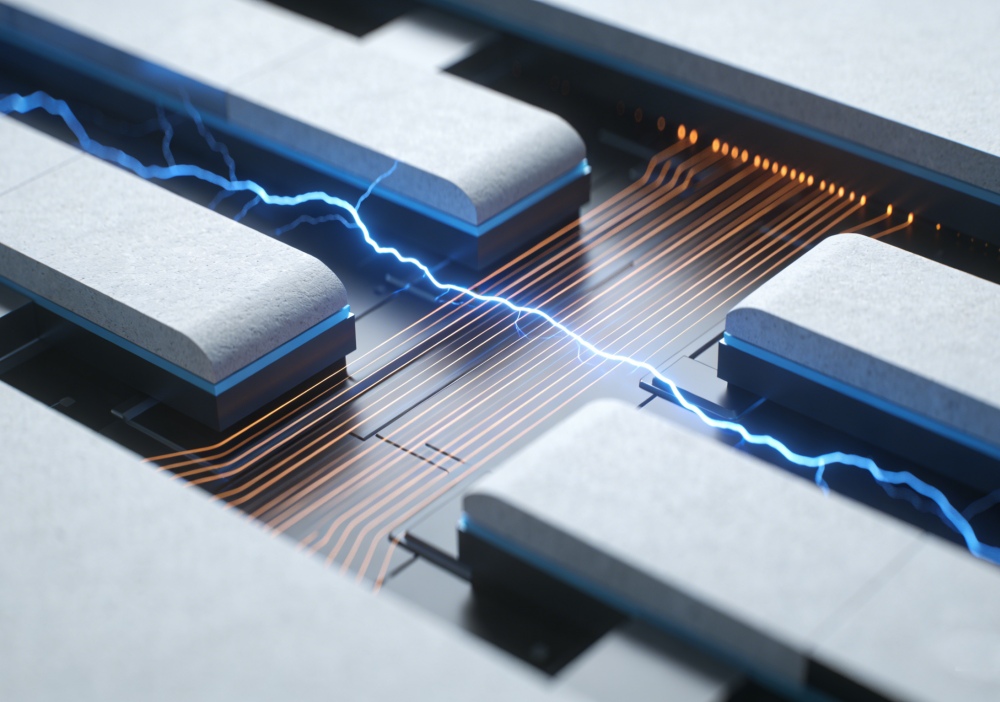
The Dielectric Constant (εᵣ), also known as relative permittivity, is a fundamental electrical property of an insulating (dielectric) material. It quantifies how much the material can concentrate electrostatic lines of flux (or store electrical energy) compared to a vacuum.
The basic formula for the capacitance of a parallel-plate capacitor illustrates its role:C = ε₀ * εᵣ * (A / d)
Thus, a material with a higher εᵣ directly leads to a capacitor with higher capacitance.
εᵣ is constant, independent of the applied electric field strength (e.g., SiO₂, most plastics). Used for predictable, linear response.
εᵣ changes with applied field strength. Ferroelectrics are a key subclass, exhibiting hysteresis and high εᵣ. Essential for tunable filters and memory (FeRAM).
Similar to ferroelectrics but without spontaneous polarization. Their εᵣ often follows the Curie-Weiss Law (εᵣ = C / (T - T_c)), useful in temperature compensation.
Identifying whether a material is linear or non-linear is just the starting point. To truly master material selection, we must look beyond static conditions and examine how these substances behave under stress. The real-world performance of a dielectric is a moving target, constantly shifting with changes in operating frequency and thermal environments. In the following sections, we will explore why the "perfect" material at 1 kHz can become a liability at GHz speeds.
The primary application. Material choice dictates capacitor size, voltage rating, frequency performance, and stability.
PCB substrates (e.g., Rogers RO4003, εᵣ~3.38) are chosen for stable εᵣ and ultra-low loss to ensure precise impedance control and signal integrity in antennas and filters.
Capacitive humidity sensors use a polymer whose εᵣ changes with water vapor absorption. Moisture in materials (e.g., grains, soil) can be gauged by measuring effective εᵣ.
The dielectric constant alone is insufficient. The Loss Tangent (tan δ) or Dissipation Factor (Df) measures the inefficiency of the dielectric material. It represents the ratio of energy lost as heat to energy stored.
Rule of Thumb: For high-frequency or high-power applications, a low εᵣ material with a very low tan δ is often preferable to a high εᵣ material with moderate loss.
The dielectric constant is not a mere lookup value in a table. It is a dynamic property that interacts with frequency, temperature, and electric field. Successful material selection for any electrical application requires analyzing the complete dielectric spectrum—the behavior of both εᵣ and tan δ across the intended operational conditions. From enabling the microscopic transistors in your phone to ensuring clear satellite TV signals, mastering the implications of this fundamental property is at the heart of modern electrical and electronic design.
| Material | Dielectric Constant (εᵣ) | Key Application |
| Vacuum | 1 (by definition) | Reference |
| Air | 1.0006 | Reference, spacing |
| PTFE (Teflon) | 2.1 | High-frequency PCBs, cables |
| Polyethylene (PE) | 2.25-2.3 | Cable insulation |
| Polyimide | 3.4 | Flexible PCBs |
| FR-4 (Epoxy Glass) | 4.3-4.8 | Standard rigid PCBs |
| Alumina (Al₂O₃, 99%) | 9.8 | RF substrates, packages |
| Silicon (Si) | 11.7 | Semiconductor substrate |
| Silicon Dioxide (SiO₂) | 3.9 | IC gate dielectric (traditional) |
| Hafnium Oxide (HfO₂) | ~25 | Advanced IC gate dielectric |
| Barium Titanate (BaTiO₃) | 1,200 - 10,000 | High-value MLCC capacitors |
| Water (Pure, 20°C) | ~80.1 | Microwave heating, solvent |
The dielectric constant should never be viewed as a standalone lookup value in a datasheet. It is a dynamic variable that must be analyzed alongside loss tangent (tan $\delta$) to ensure long-term reliability and signal integrity. Successful electrical design requires a holistic view of the dielectric spectrum—balancing energy density with thermal and frequency stability. By mastering these fundamental interactions, engineers can push the boundaries of what’s possible in everything from power electronics to high-speed communication.
 Goodkey Machinery Import & Export Co., Limited



Leave A Message
Scan to Wechat/Whatsapp :